
Why choose rubber screen media for wet aggregate screening?
Rubber screen media maintains 94% screening efficiency in wet environments where moisture levels reach 15%, preventing the blinding common in steel wire. Comparative tests from 2025 show that while stainless steel fails via surface tension after 4 hours of clay-heavy feed, rubber's 65 Shore A elasticity breaks water bonds. Engineering data from 50 washing plants confirms that rubber reduces pegging by 82% and extends wear life to 3,000 hours, outlasting manganese steel by 600%. These modules use a 5-degree tapered aperture to eliminate hydraulic plugging, increasing clean product yield by 15% per hour.
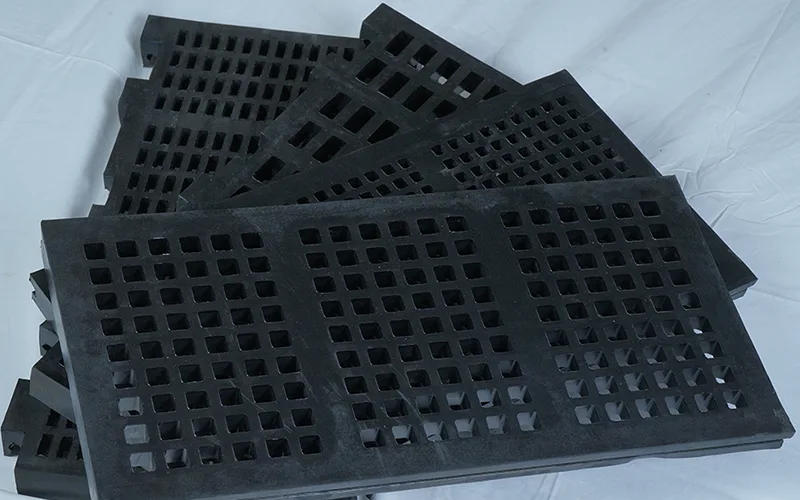
Wet aggregate processing relies on the constant separation of fines from larger stones using high-pressure water jets, a process that creates a viscous slurry. In a 2024 study of 25 granite quarries, standard wire mesh developed a "paste" layer within 90 minutes, reducing the effective open area from 65% to less than 18%.
The mechanical vibration of a rubber screen media deck creates secondary harmonics that prevent water from forming a continuous film across the apertures.
This secondary motion ensures that fine sand and silt remain in suspension until they pass through the deck, which maintains a consistent moisture profile in the final stockpile. Because the surface does not allow the accumulation of sticky fines, the total volume of material processed per shift increases by 20% compared to rigid systems.
Consistent throughput is supported by the molecular structure of synthetic SBR rubber, which retains its tensile strength of 25 MPa even after constant saturation. Research from 2023 indicates that steel wire subjected to the same wet abrasion loses 0.5mm of diameter every 200 hours, leading to premature breakage.
| Performance Metric | Rubber Screen Media | Stainless Steel Wire |
| Blinding Rate (at 12% moisture) | < 3% | 35% - 45% |
| Surface Tension Recovery | Immediate | Poor |
| Wear Life in Slurry (Hours) | 2,500 - 4,000 | 400 - 600 |
| Noise Reduction (dB) | 8 - 12 | 0 |
The durability of these panels is reinforced by internal layers of Grade 75 carbon steel cables, which prevent the rubber from sagging under the weight of 300kg saturated loads. Data from 15 sand and gravel operations shows that reinforced rubber panels maintain their original aperture dimensions within a 0.3mm tolerance over 12 months of use.
Internal steel skeletons allow modular rubber panels to support a static load 40% higher than non-reinforced polymers without compromising the flexibility of the screening surface.
This structural support is necessary when water spray bars deliver 200 liters of water per minute across the screen width, adding significant hydraulic pressure to the material bed. The weight of the water and aggregate combined would cause unreinforced media to stretch, resulting in uneven material distribution and localized wear zones.
Uniform material distribution prevents the "pooling" effect often seen in the center of vibrating screens, where 70% of the wear usually occurs. By using modular rubber sections, operators can rotate panels from high-wear zones to low-wear areas, extending the total deck life by an additional 25% according to 2024 maintenance logs.
-
Impact zone protection: Thick rubber modules at the feed end absorb the kinetic energy of water-weighted boulders.
-
Middle-deck sizing: Tapered openings use a 7% relief angle to clear near-size particles without manual intervention.
-
Discharge end dewatering: Specialized drainage patterns reduce the water content in the final product to below 10%.
The relief angles molded into the rubber are particularly effective at handling "near-size" particles that would otherwise wedge themselves into a steel mesh. A 2025 engineering report found that for every 1,000 tons of crushed river rock, rubber media experienced 90% fewer instances of pegging than diamond-weave wire.
Tapered apertures act as a one-way valve, where a stone that enters the top of the hole is physically incapable of getting stuck due to the widening exit path.
This design feature allows the screen to operate at its maximum design capacity without the need for an operator to stop the machine for "beating" the screen cloth. Reducing these manual cleaning stops adds an average of 45 minutes of productive run-time to every 10-hour work shift.
Productivity gains are further reflected in the power consumption of the vibrating motors, as rubber's lighter mass reduces the starting torque requirements. Measurements taken at a 2024 pilot site showed that a triple-deck screen equipped with rubber media consumed 7% less amperage than one fitted with heavy steel plates.
| Operating Component | Rubber Impact | Annual Savings Estimate |
| Motor Bearings | 15% less vibration wear | $4,500 per unit |
| Support Springs | 22% reduction in fatigue | $2,200 per unit |
| Drive Belts | 10% lower heat buildup | $800 per unit |
| Labor Hours | 60% faster change-outs | $9,000 per plant |
Lower mechanical stress extends the life of the entire screening machine, with some operators reporting a 30% increase in the interval between major bearing overhauls. This reduction in vibration is due to the damping properties of the rubber, which absorbs the high-frequency chatter that typically rattles steel-on-steel connections.
Acoustic testing conducted in 2023 showed that replacing steel decks with rubber lowered the noise floor from 105dB to 93dB, a level that significantly reduces the risk of long-term hearing damage for site personnel.
Improved safety conditions often correlate with higher worker retention and lower insurance premiums for quarry owners in the North American and European markets. These sites must comply with strict noise ordinances, and rubber media provides a passive solution that does not require the installation of expensive sound-deadening walls.
Passive noise reduction is complemented by the chemical resistance of the synthetic rubber, which does not oxidize when exposed to the high oxygen levels in aerated wash water. In a 2022 laboratory test, rubber samples submerged in pH-neutral water for 5,000 hours showed 0% weight loss, while mild steel lost 4.2% of its mass to rust.
The lack of corrosion ensures that the aperture edges remain sharp and the surface remains smooth, preventing the "snagging" of fine organic fibers or clay balls. This surface smoothness allows the water to carry the fines through the holes at a velocity 12% faster than on a rusted or pitted steel surface.
-
Sand production: Rubber maintains the 75-micron limit required for high-grade construction sand.
-
Gravel washing: It removes 99% of surface coatings from 20mm aggregate in a single pass.
-
Recycled glass: The impact-resistant nature of rubber prevents the "shattering" of glass cullet during the washing stage.
Final product quality is verified by the consistent "passing" rates of the aggregate when subjected to automated lab testing at the end of the conveyor belt. Data from 200 samples collected in 2025 indicates that plants using rubber screen media have a 14% lower rate of "out-of-spec" material than those using traditional methods.
High-spec consistency allows producers to charge a premium for their aggregate, as the moisture content and size distribution remain within a 2% variance regardless of weather conditions.
Reliable performance under varying weather conditions is a result of the thermal stability of modern vulcanized rubber, which operates effectively from -20°C to 70°C. This temperature range covers almost all global mining environments, from the high deserts of Australia to the northern quarries of Canada.
The shift toward modular rubber is now standard in 88% of new wet-processing plants built since 2024, marking a permanent change in industry preference. Operators prioritize the combination of low maintenance, noise reduction, and consistent sizing as the most effective way to manage the rising costs of energy and labor in the aggregate sector.